When you purchase through links on our situation , we may bring in an affiliate commission . Here ’s how it works .
3 - D printers that invent interestingly shaped foods or plastic wrenches certainly have their stead , but a Modern technique that prints out artificial blood cells may take the engineering to the next storey by actually salve lives . These stilted rake cells represent an significant measure in the evolution of artificial electric organ transplants , since the current genesis of artificial organs lack the vascular web need to function properly .
Designed by scientists at Germans ' Fraunhofer Institute , the technique involves printing artificial biologic molecules with a 3 - five hundred inkjet printer , and then zapping the those speck with a laser that forms the textile into the shape of stemma vessels . Like literal pedigree vessels , the artificial vessels have two layers and can form complex separate structures .
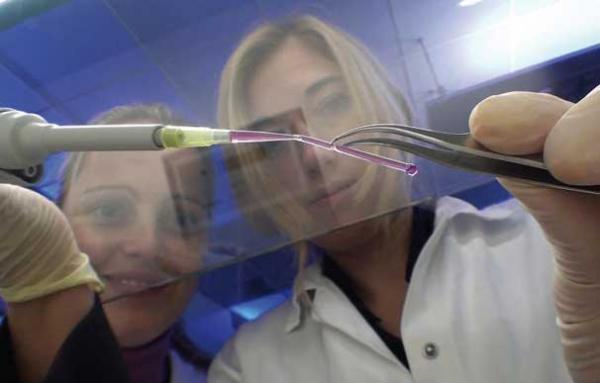
Credit: Fraunhofer IGB
" We are establish a basis for applying speedy prototyping to pliant and organic biomaterials , " enjoin Günter Tovar , project managing director of the Fraunhofer Institute hokey blood vessel program . " The vascular systems exemplify very dramatically what opportunities this technology has to extend , but that ’s definitely not the only affair potential . "
A 3 - 500 inkjet printing machine can sire 3 - dimensional solids from a extensive variety of materials very quickly . It apply the stuff in layers of limit frame and these layers are chemically bind by UV radiation syndrome . This already creates microstructures , but 3 - 500 printing technology is still too imprecise for the fine structures of capillary vessels . This is why these researchers need the laser .
abbreviated but intensive laser impulse touch the material and stimulate the molecules in a very small focus point so that linking of the molecules go on . In this manner highly precise , elastic structures are build concord to a 3 - five hundred construction programme .

The recent line vessel have to be elastic and interact with the natural tissue . Therefore , the man-made tubes are biofunctionalized so that living consistence cells can dock onto them . The scientist integrate modified biomolecules into the inside walls . In the second step , the cells that form the innermost wall layer of each vessel in the trunk can attach themselves in the tube system .
In improver to providing the vasculature for artificial electronic organ , 3 - D print blood vas could have a medical wallop by themselves , serving as constitutional ringway for people with choked arterial blood vessel or as replacement capillaries for smoking car .
Thus far , the Fraunhofer researchers admit that this engineering remain in the research phase , a way away from implementation . However , this advance will almost certainly serve as a accelerator , boosting development in the related arena of 3 - D printed organs .