The ancient flying reptile dubbedThanatosdrakon amarulived on Earth between 146 million and 66 million years.
Leonardo D. Ortiz DavidThis ancient flying reptilian once dominated the skies over South America .
While supervising a civil grammatical construction project near Mendoza , Argentina , paleontologists made an incredible find . There in the rock , they uncovered the fossilized clay of two ancient flying reptilian that appeared to go to a unexampled species of pterosaur . They ’ve dubbed the findThanatosdrakon amaru , or “ dragon of dying . ”
“ We do n’t have a current record of any close congenator that even has a trunk modification exchangeable to these beasts , ” Leonardo D. Ortiz David , the tether author of a new study describing the discovery and the coordinator general of Argentina ’s Laboratory and Museum of Dinosaurs , toldReuters .

Leonardo D. Ortiz DavidThis ancient flying reptile once dominated the skies over South America.
ToUSA Today , he added : “ The cadaver ofThanatosdrakonpresent different particularities that allow us to differentiate them from other known pterosaurs . Fundamentally , these characteristics are found in the vertebrae and limbs . This admit us to establish a raw metal money of pterosaur . ”
Indeed , Thanatosdrakon amaruis the large pterosaur ever discovered in South America , and one of the largest ever found in the world . Live Sciencereports that its genus name , Thanatosdrakon , commingle the ancient Greek word for “ Draco ” and “ death , ” whereas its species name , amaru , intend “ flying snake ” in the Indigenous Quechuan language and is a nod to a two - headed Incan god .
“ It seemed appropriate to name it that manner , ” Ortiz explicate toReuters . “ It ’s the dragon of death . ”

Leonardo D. Ortiz DavidLeonardo D. Ortiz David with a model of the dragon of death he helped discover.
Leonardo D. Ortiz DavidLeonardo D. Ortiz David with a model of the dragon of death he helped discover .
The firedrake of death experience between 146 million and 66 million age ago — or 20 million years before a catastrophic asteroid struck the earth . A new species of azhdarchid , a kind of pterosaur that live during the Late Cretaceous Period , it was likely one of the first predator to hunt from the skies .
“ Azhdarchids were known for their very large skulls — sometimes larger than their body — as well as their hyper - elongated necks and poor , robust consistency , ” Ortiz explain toLive Science .
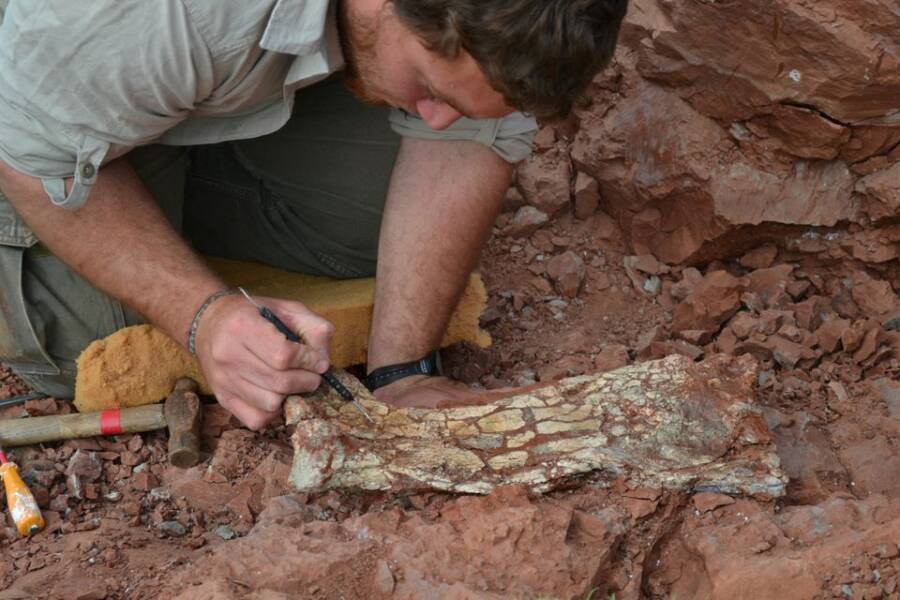
Leonardo Ortiz David – Universidad de CuyoA paleontologist at work uncovering the pterosaur bones found in Argentina.
To make thing even more exciting , Ortiz and his team did n’t get just oneThanatosdrakon amaruin Argentina , but two . The first , which appear to be an adult , has a wingspan of 30 feet . The second , which looks like a juvenile person , has a smaller wingspread of 23 foot . Researchers are unsure , however , if the two are related .
“ There is no reading in the fossil remains of a degree of paternal relationship , ” Ortiz explained toLive Science . “ However , it can be confirmed that both specimens are of dissimilar sizes , and that the smaller one is a juvenile - subadult , and that they were together when they died more than 86 million years ago . ”
Leonardo Ortiz David – Universidad de CuyoA paleontologist at work uncover the pterosaur bones found in Argentina .
Ortiz also toldLive Sciencethat theThanatosdrakon amaruremains learn by his team are in outstandingly expert term .
“ From the beginning , two facts caught our attention : The first was the size of the remains and their preservation in three property , an unusual condition in this mathematical group of vertebrates , ” he tell . “ The 2nd was the amount of remains found at the land site , since large - giant pterosaurs are only have it off from fragmentary remains ( with some exception ) . ”
Today , theThanatosdrakon amarufossils are being held at the Laboratory and Museum of Dinosaurs at the National University of Cuyo in Mendoza , and a detailed replica of the creature is on display for everyone to lay eyes on its stunning size .
After reading about the “ Draco of death ” discovered in Argentina , discover the write up of thequetzalcoatlus , the largest flying reptile to ever live . Or , see how paleontologists found the fossilised nest of dinosaurs calledMussaurus patagonicus — include entire egg .
