When you buy through links on our site , we may earn an affiliate committee . Here ’s how it works .
A mystic Martian mineral that has perplexed scientists since its discovery seven year ago may have been skewer out during an unusual volcanic eruption , researchers have revealed . The mineral , which is unremarkably only found onEarth , was belike formed on the Red Planet more than 3 billion age ago .
NASA’sCuriosityrover discovered the mineral inside a rock’n’roll at the heart of the 96 - mile - wide ( 154 kilometers ) Gale crater on July 30 , 2015 . The scouter drilled a pocket-size hole into the rock and extracted a silver - colorise debris sample . Curiosity ’s onboardX - raydiffraction laboratory analyzed the junk and notice tridymite — a rare type of quartz made totally of Si dioxide , or silica , that is formed by sure eccentric of volcanic activity .
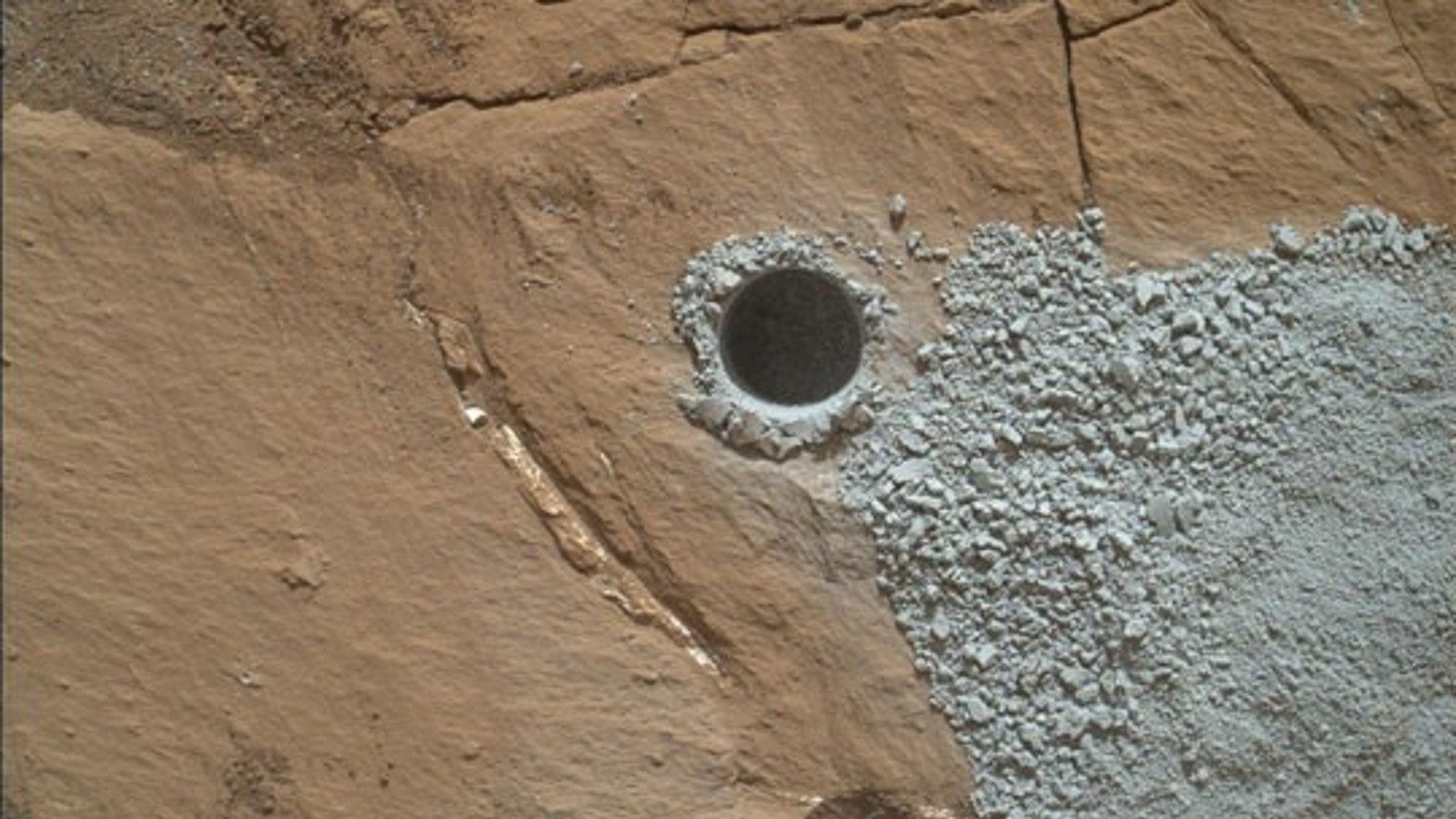
Silver-colored dust drilled from a rock by NASA’s Curiosity rover on 23 February 2025. Analysis of the dust revealed it contained the mineral tridymite, which was very unexpected.
The strange find was totally unexpected . " The discovery of tridymite in Gale crater is one of the most surprising observation that the Curiosity rover has made in 10 years of explore Mars , " study co - generator Kirsten Siebach , a planetary scientist at Rice University in Houston and a commission specialist on NASA ’s Curiosity team , said in a statement .
The discovery of tridymite stunned researchers for two main rationality , lead-in study author Valerie Payré , a global scientist at Northern Arizona University and Rice University , told Live Science in an email . First , Mars ' volcanic activity was previously thought to be undesirable for producing silica - full-bodied minerals like tridymite . secondly , scientist consider Gale crater was once an ancient lake , and it has no visible volcano nearby , which left scientists scratching their foreland as they tried to cypher out how the mineral terminate up at the bottom of the lake , Payré said .
relate : Curiosity rover snaps close - up of tiny ' mineral flush ' on Mars

NASA’s Curiosity rover snapped this low-angle selfie next to the rock where it extracted the tridymite from.
In the new discipline , researchers have get along up with an explanation that may at long last unknot the mystery . The researchers suspect that the explosive eructation of an unknownvolcanolaunched tridymite - rich ash into the Martian sky , which then fell into the ancient lake at Gale crater .
When the ash fell into the water it would have been founder down into its individual parts by a combination of physical and chemical substance processes . The investigator think this is why the sampling of tridymite is so pure and not pollute with ash . " If the ash were right away deposited at the position we found it [ without urine ] , we would bear heavyset stratum " of ash , Payré said .
A similar scenario has been observed on Earth at just one location — at Lake Tecocomulco in Mexico , where tridymite was establish within volcanic rocks brought up from the bottom of the lake .

If tridymite - copious ash tree did descend into Gale crater when it was still a lake , then the clap likely occur between 3 billion and 3.5 billion year ago , which is when researchers mistrust the volcanic crater was full of weewee . " The volatile eruption must have happened in that time flesh , " Payré tell . However , late studies have usher it is possible that Gale volcanic crater was still a lake as recently as 1 billion days ago , accord to the researcher ' statement .
The researchers stay on timid about where the vent that birthed the tridymite sample is settle on the Red Planet . It could have been from a small eruption nearby , or from a monolithic explosion much further abroad , Payré said . It is hard to locate past volcano on Mars because it is challenging to distinguish between impact crater and volcanic caldera that have been eroded over billions of years , she added .
The researchers also had to explain how tridymite formed on Mars , where conditions are thought to be very different from Earth .

ordinarily , tridymite form in extremely high - temperature and silica - rich volcanic environments , which are common on Earth , Payré said . However , old evidence from Mars suggests that volcanic eruptions on the Red Planet were basaltic , think that they had a much - reduced silica subject . This is because Mars does n’t havetectonic plate , which are the principal source of Earth ’s silica - rich eruptions , Payré impart .
Further analysis of the tridymite found on Mars revealed that it was slenderly different to the tridymite that forms in vent on Earth . This hint that the Martian version was constitute under somewhat dissimilar stipulation , Payré said .
tie in : Martian crater look just like a human fingermark in this incredible new image

The researchers purpose that the tridymite bump in Gale crater was formed over a extend period within a magma bedchamber underneath the unidentified vent . Thetemperaturewithin the chamber would likely have been more or less broken than the conditions in tridymite - forming volcanoes on Earth , but the team believe this might have start the mineral to slow form as extra silica became available , grant to the study .
Similar mineral organization pathways have been observe on Earth , and the scenario be the " straightforward organic evolution of other volcanic rock and roll we found in the crater , " Siebach said .
Although the offer formation of tridymite on Mars requires less silica than on Earth , the researchers direct out that the vent that birthed the sampling found in Gale crater likely had a high silica mental object than past evidence suggest .

— Bizarre ' polygons ' are cracking through the open of Mars
— Mars ' oldest meteorite trace to strange double encroachment crater
— Giant artificial lake of ' out of sight urine ' chance upon on Mars

" This work suggest that Mars may have a more complex and intriguing volcanic history than we would have imagine before Curiosity , " Siebach sound out .
next breakthrough from Curiosity and its successor , the Perseverance rover , as well as Martian rocks brought back to Earth by NASA ’s proposed Mars Sample Return deputation , could help drop more illumination on Mars ' ancient volcanic past , Payré said .
The study will be published in the Sept. 15 issue of the journalEarth and Planetary Science Letters .

in the beginning publish on Live Science .


