When you buy through links on our situation , we may earn an affiliate commission . Here ’s how it solve .
Sometimes , find nothing is just as good as finding something .
physicist have made the most tender measure yet in the Richard Morris Hunt for a rare event that could undermine the dominant theory of speck physics , and turned up zilch .

This large copper cylindrical vessel is the Enriched Xenon Observatory 200’s (EXO-200) time projection chamber, the part of the detector that contains the liquid xenon, isotopically enriched in xenon-136. The photo shows the chamber being inserted into the cryostat, which keeps the experiment at extremely low temperatures.
The scientists , who are searching for a rumor mote decay operation shout " neutrinoless twofold - genus Beta decay , " guide a delicately tune detector for almost seven months , and found no significant data to hint the summons occurs . That non - detection intimation that exotic particle calledneutrinosmay be more mundane than some have call back .
" The outcome could only have been more exciting if we ’d been hit by a stroke of chance and detected neutrinoless doubled - genus Beta disintegration , " Stanford University physicist Giorgio Gratta , spokesperson for the experimentation , called the Enriched Xenon Observatory 200 ( EXO-200 ) , enjoin in a statement .
The scientist recorded only one signal ( or upshot ) that might have represented neutrinoless dual - beta disintegration occuring . " That have in mind the background activity is very low and the demodulator is very tender . It ’s capital news program to say that we see nothing ! " Gratta added .
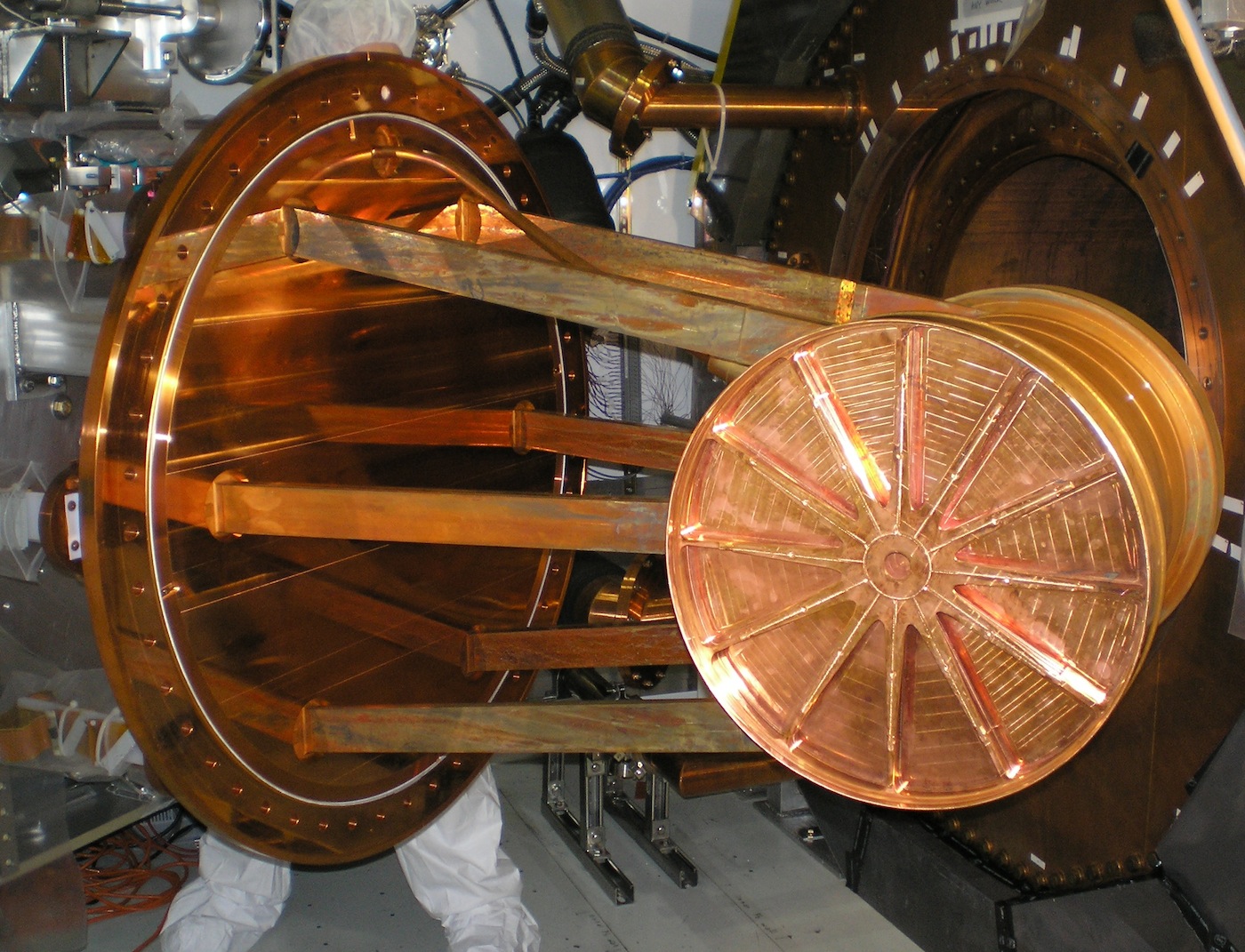
This large copper cylindrical vessel is the Enriched Xenon Observatory 200’s (EXO-200) time projection chamber, the part of the detector that contains the liquid xenon, isotopically enriched in xenon-136. The photo shows the chamber being inserted into the cryostat, which keeps the experiment at extremely low temperatures.
unsound atomic lens nucleus ( the patchwork of protons and neutron that make up the nucleus of atoms ) will often lose a neutron in a process bang as beta decay . The neutron turns into a proton by releasing an negatron and a tiny corpuscle anticipate a neutrino .
Sometimes , two neutrons are lose in a process called double - beta decay , which usually releases two electrons and twoantineutrinos(theantimatter partner particlesof neutrinos ) . But scientist have also theorized that neutrinoless double - beta decay could come about , which would bring on two electrons and no antineutrinos . [ Infographic : Nature ’s Tiniest Particles dissect ]
" People have been look for this unconscious process for a very foresighted time , " said Petr Vogel , an emeritus physicist at Caltech and a member of the EXO-200 squad . " It would be a very fundamental discovery if someone actually note it . "

If such an event occurs , it must be because the two neutrino release have somehow scratch each other out . That would mean that theneutrino is its own antimatter spouse , and that the two neutrino had annihilated each other , as all thing and antimatter partner corpuscle do when they encounter .
If that is the event , it would contradict the forecasting of the Standard Model , the reigning aperient theory describing known subatomic particles . Thus , if physicists ever do see neutrinoless twofold - genus Beta decay , the Standard Model will need revision .
To explore for this decay , the Enriched Xenon Observatory 200 expend a copper cylinder fill up with 440 pounds ( 200 kilogram ) of liquid xenon-136 — an fluid isotope that may be able to undergo neutrinoless decay . At both ends of the cylinder , sensible demodulator are placed to catch the signals of beta decay .

The whole detector is bury 2,150 feet ( 655 beat ) underground in the Department of Energy ’s Waste Isolation Pilot Plant in Carlsbad , N.M. , to preclude contamination from other particles .
For normal double - beta decay , the half life — the time it consume for half the substance to crumble — is 1021years , or 100 billion time longer thanthe age of the cosmos . base on the results of the experiment , the investigator can now say that the half life of the neutrinoless decline process is no curt than 1.6 × 1025years , or a quadrillion times longer than the age of the universe .
Still , scientists are n’t giving up the hunt for neutrinoless decline . If it can be proven that the neutrino is its own antiparticle , it could facilitate explain why our universe is made of matter and not antimatter .

Scientists think the universe started off with just about equal parts topic and antimatter after the Big Bang . Yet somehow , a nimiety of issue was leave alone over after the mass of the two annihilated each other . To chance upon how this might be , scientists necessitate to obtain an asymmetry between the fashion matter and antimatter behave .
If the neutrino and the antineutrino are one and the same , that may point the way toward an imbalance that could solvethe antimatter riddle .
you may follow LiveScience senior writer Clara Moskowitz on Twitter @ClaraMoskowitz . For more science news show , follow LiveScience on twitter @livescience .